
Part One Lucian's Tag
Keeper Pamphilus wore two identification tags around his neck: his own and another man's. The second had belonged to Lucian — the friend with whom he had received the Keeper's seal fifteen years ago, with whom he had served at three outposts, and with whom he had dreamed of someday retiring to a quiet planet where no one had ever heard of Rifts.
Lucian had died a year ago. A convoy carrying medicine to the farthest settlements was intercepted by raiders of the Haar clan — they took nothing but the cargo, yet they spared none of the convoy's defenders. Pamphilus reached the site an hour later. He found the tag among the wreckage and had not taken it off since.
The Order knew that the Haar were avenging old wrongs, that behind every raid stretched a chain of older deaths in which no first offender could be found. For Pamphilus this knowledge was worth nothing. He served at Sentinel Station — a small post on the border of the Haar lands — and every day he looked toward their territory with a feeling he admitted to no one, not even at confession.
He called it righteous anger. Old Keeper Eutychius, who had served at Sentinel longer than anyone, called it something else, but for now he said nothing.
Part Two The Burning Skiff
On the night before Sunday the station's alarm sounded: three kilometers from the landing pad a light skiff had crashed and was engulfed in flames. Pamphilus was first to reach the site — alone, in a single suit, without backup, because backup was four minutes away and, by his reckoning, the fuel tanks would go in less.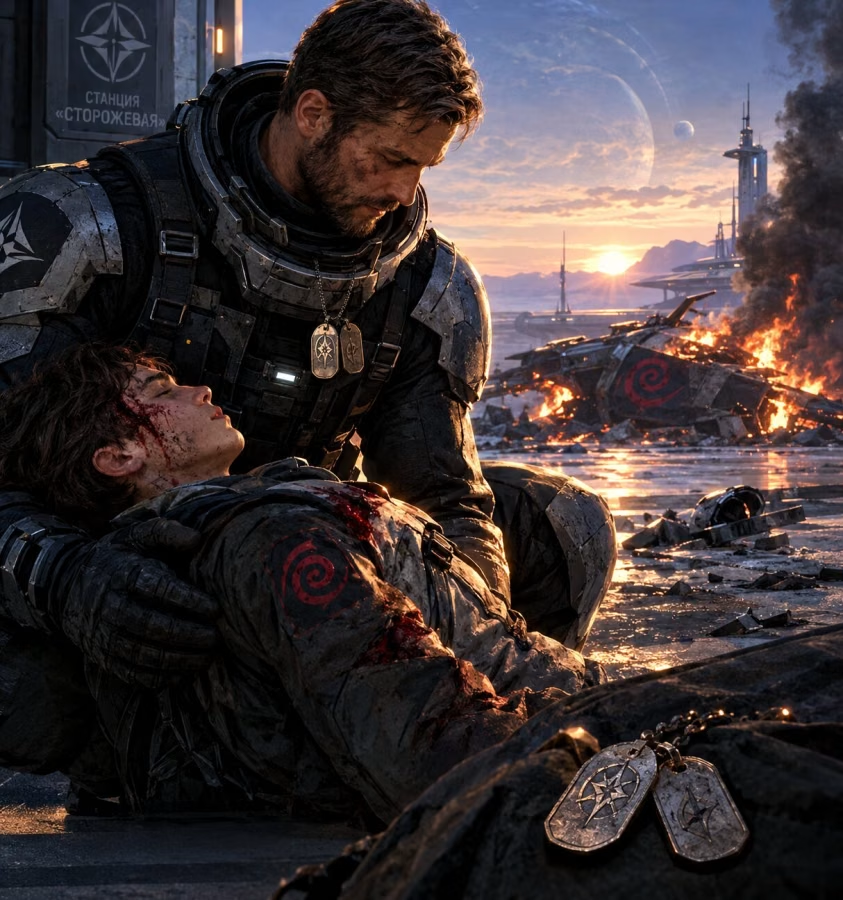
In the skiff's cabin lay a youth of about seventeen, pinned beneath a collapsed bulkhead. On the scorched hull was a mark: a red spiral on black — the clan sign of the Haar.
Pamphilus froze.
It lasted only a few seconds, but he would remember them forever: flames already licking at the neighboring compartment, the youth groaning without regaining consciousness, and in Pamphilus's head a quiet, clear voice — not like anger and not like conscience — saying what he had heard at service the day before. "As ye would that men should do to you, do ye also to them likewise."
"If Lucian were lying there," Pamphilus said aloud, though no one could hear, "I would want someone to stop."
He braced his shoulder against the fallen bulkhead and shoved it aside, burning himself through the glove of his suit. He carried the youth out in his arms forty seconds before the skiff exploded.
"And as ye would that men should do to you, do ye also to them likewise. For if ye love them which love you, what thank have ye? for sinners also love those that love them. And if ye do good to them which do good to you, what thank have ye? for sinners also do even the same."
— Luke 6:31–33 (KJV)From the Teaching of Keeper Theophan the Recluse · On Luke 6:31–36
"The Lord does not deny that loving those who love us is good; He says only that it is not enough to be called His disciple. A love turned only toward those who repay it remains a trade, however noble: it differs in nothing from the love known to every person who has never heard the Gospel. Christian love begins where the counting stops of who owes what to whom."
"An enemy is not the one we must name an enemy in order to feel righteous, but the one whose situation demands the best of us. The commandment does not ask us first to feel warmth toward him: it asks us to do for him what we would want done for ourselves in his distress. Warmth comes later — often much later, and sometimes not at all — but mercy that waits for warmth usually never arrives."
Part Three Love Ye Your Enemies
The youth's name was Tarek, and he woke on the third day in the station infirmary, seeing above him the familiar and hated sign — the silver seal of a Keeper.
"Kill me now," he said dryly, not trying to rise. "If you're not going to interrogate me, why heal me?"
"No one is going to kill you or interrogate you," Pamphilus answered, standing by the door and not coming closer. "You're hurt. That is all I need to know."
"Liar. Your people killed my brother two years ago. I saw it."
"Mine did," Pamphilus agreed. "And yours killed my friend. I found his tag."
Tarek turned his face to the wall.
In the days that followed Pamphilus brought him food, changed his dressings, and never spoke of the past. He did not try to thaw the youth with kind words — he had none, and he did not want false ones. He did only what he would have done for a friend: made sure the water was warm, and at night left a dim light on, because he had heard Tarek cry out in his sleep from the fire.
"You're under no obligation to do this," Eutychius told him one evening, watching from the corridor. "The Order does not require you to tend a wounded raider. It is enough to return him to his clan."
"I know," Pamphilus answered. "I'm not doing it because I must."
"Then why?"
Pamphilus was silent a long time.
"Because at that moment by the skiff I understood: if I stopped, I would become a man Lucian would not have recognized," he said finally. "And I want to remain the man he knew, for as long as I am here."
Part Four The Unthankful and the Evil
Two weeks later the elders of the Haar came to the station to demand the return of their son. They were cold and distrustful and behaved as though they expected to find proof of a crime at the post.
Pamphilus brought Tarek to the gate. The youth held himself straight, though he still limped, and never once looked at the Keeper while the elders examined his wounds.
"He was injured in the crash," Pamphilus said. "We pulled him from the burning skiff and treated him for two weeks. We have nothing more to add."
The eldest of the elders nodded without gratitude, as if receiving what was owed. Tarek climbed aboard the strangers' ship in silence and did not look back.
The airlock closed. The ship departed.
"Didn't even say thank you," remarked one of the younger Keepers standing nearby.
"I never asked him to," Pamphilus answered.
He felt no bitterness — neither the kind he had expected, nor the quiet joy he had perhaps secretly hoped for. There was only an empty, calm feeling, like after heavy work done not for praise. Beside that feeling he suddenly remembered the words of today's Gospel: "hoping for nothing again." He understood that at the moment by the skiff, for the first time in his life, he had expected nothing at all.
Epilogue Merciful, as the Father
In spring another convoy of medicine crossed the border of the Haar lands without a single shot fired. The Keepers of Sentinel had expected an ambush, as always — and none came. No one explained it, and no one sought to find out.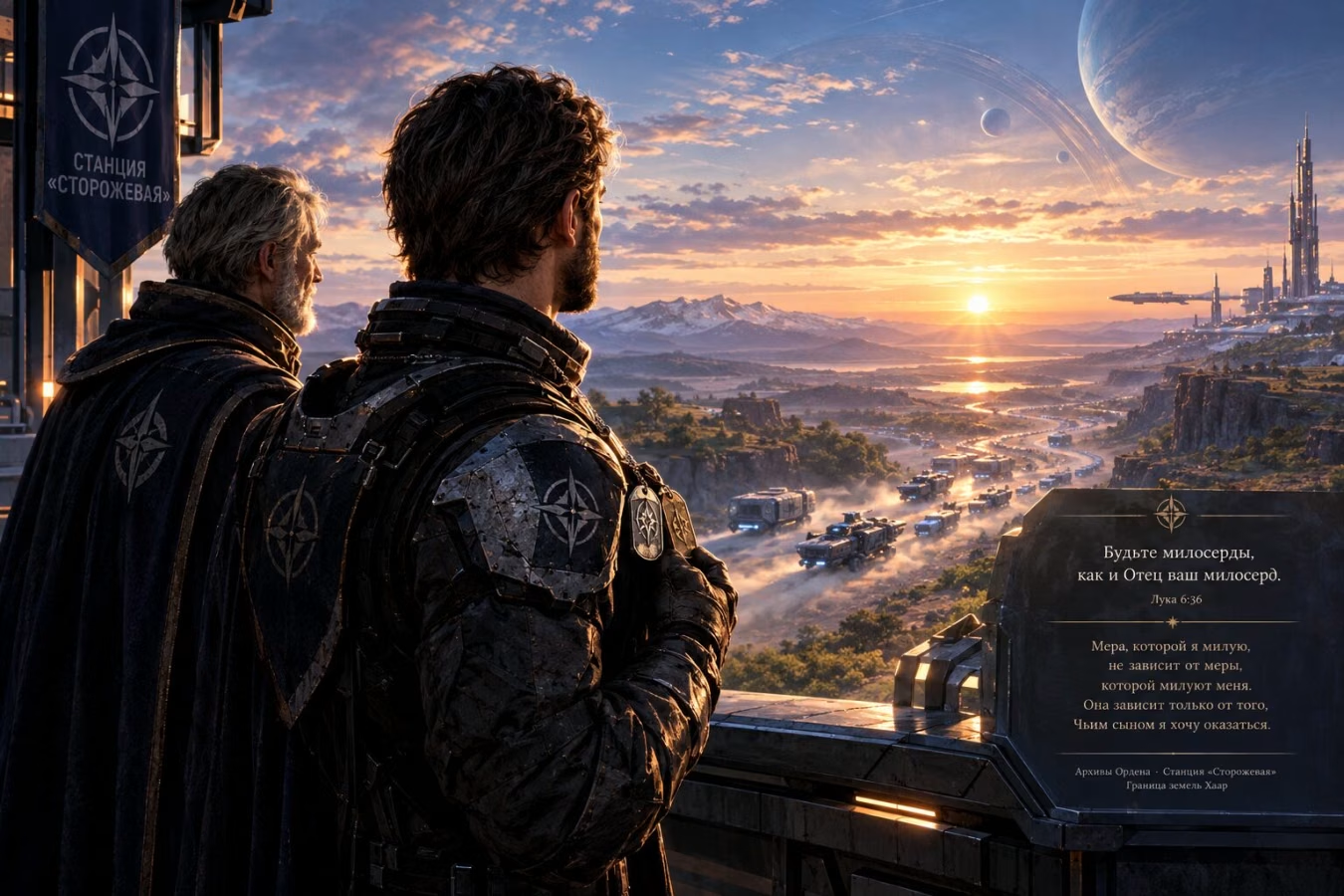
Pamphilus stood on the observation deck and watched the convoy stretch along the horizon.
"Do you think it was because of him?" Eutychius asked, coming up behind.
"I don't know," said Pamphilus. "And I don't want to know. If I start counting how much came back to me for it, mercy will turn into trade again."
Eutychius smiled.
"That is what it means to be a child of the Highest: to be merciful not because it will be repaid, but because He Himself is so — kind to the unthankful and to the evil."
Pamphilus touched the two tags on his chest.
Be ye therefore merciful, as your Father also is merciful.
The measure with which I show mercy does not depend on the measure with which mercy is shown to me. It depends only on whose child I wish to be.
Order Archives · Sentinel Station · The Haar Border
The rescue operation following the crash of a Haar clan light skiff was carried out by Keeper Pamphilus on his own initiative, without authorization and without backup. The casualty, a minor, was handed over to the clan elders without conditions after two weeks of treatment.
A medical convoy crossing the Haar border in the spring season met no resistance. A connection between the two events has not been established and is not claimed.
Eutychius's note: "We like to keep accounts of mercy, as merchants keep accounts of profit. But mercy that has presented its bill ceases to be mercy. The only reward that can be accepted without spoiling the deed is the one that was never asked for."
