
Part One The Habit of Loss
Keeper Theodotus had served the Order as a healer on the far frontiers for twenty years, and he had long since stopped counting how many he had seen off on their last journey. At first he kept records: name, age, cause. Then the records shrank to numbers, and the numbers to a single line in the quarterly report.
He did not think himself hard-hearted. He thought himself experienced. An experienced healer knows that the pain you let in each time has no bottom. And he learns to stand before another's grief the way one stands at the rail of a storm-tossed deck — firmly, and a little to one side.
Old Keeper Sabbatius, Theodotus's mentor, had warned him long ago: "Guard not your heart, but the living thing within it." Theodotus had nodded and guarded his heart — so well that one day he noticed he was no longer surprised by anything and pitied no one, but merely acted correctly.
That morning he was leading a small convoy of medicine to Nahor Colony. Two young Keepers walked with him, and a dozen or so settlers who had joined the convoy along the way. At dawn, before setting out, Theodotus had listened to the reading of the Gospel about the widow of Nain — listened the way one listens to something familiar — and had felt nothing.
Part Two The Bier
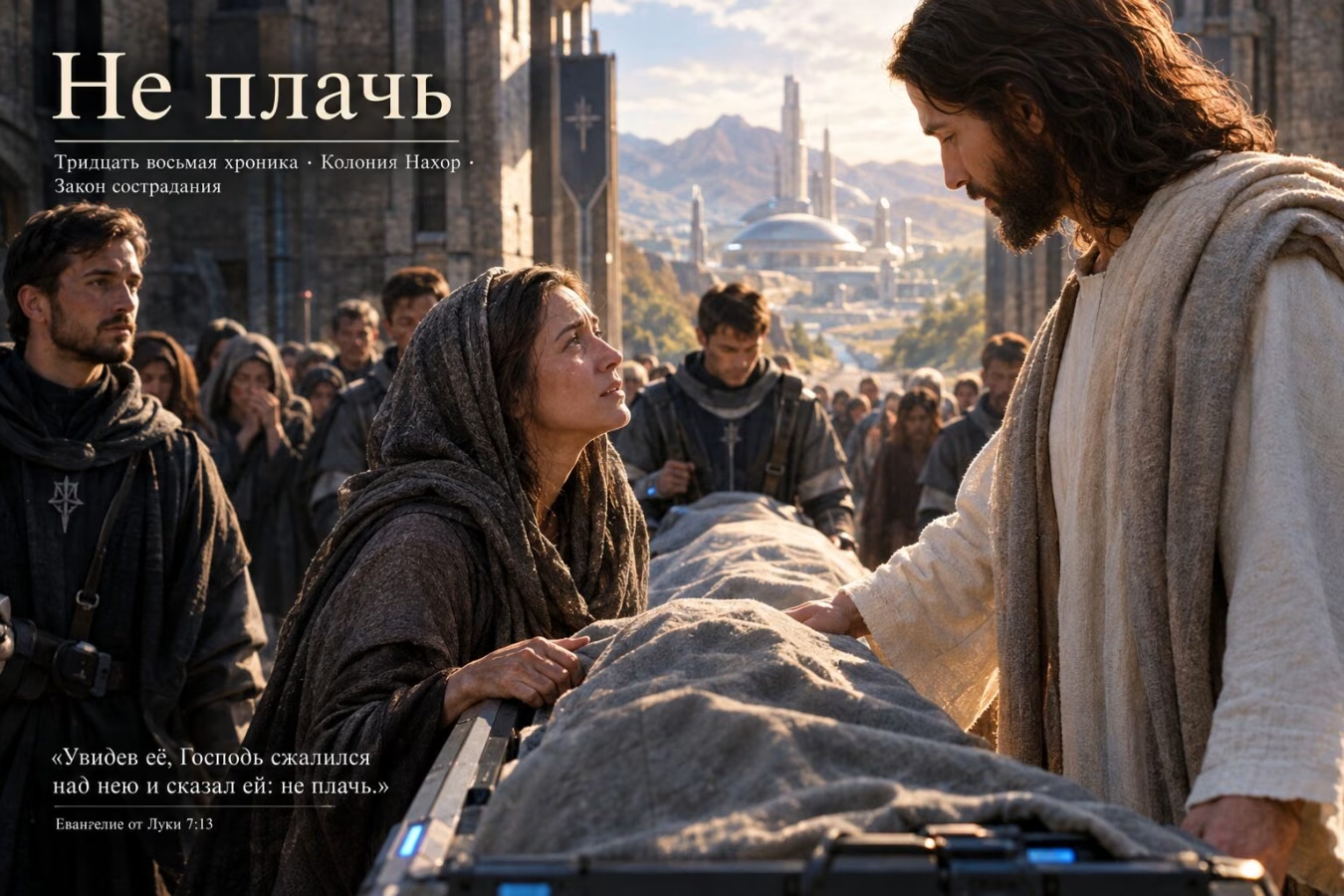 At the colony gate the convoy met a procession. A grav-platform without lights, and on it a slender form beneath a gray cloth, four bearers at its sides. Many people followed: the colonists were silent as people are only at funerals where everyone knows the dead was far too young.
"Myron, son of Eupraxia," one of the settlers said quietly; he had asked the guard. "The mine airlock failed. The colony's doctor worked on him for forty minutes. He was her only son. Her husband died in the early years, at the Rift."
Theodotus nodded. He had heard such words hundreds of times and knew what one was supposed to answer so that it sounded fitting.
Then he saw her.
She walked behind the platform and did not weep. Weeping is already movement, and in her everything had stopped. One hand rested on the edge of the platform, as though she feared that if she let go she would be swept away. Theodotus had once seen such a face in a mirror and had not remembered it for twenty years.
No one had called him. The colony had its own doctor, its own rites, its own grief. But something in him, long forgotten and securely locked away, trembled — and clenched so hard that he stopped in the middle of the road.
"And when the Lord saw her, he had compassion on her, and said unto her, Weep not. And he came and touched the bier: and they that bare him stood still."
— Luke 7:13–14 (KJV)From the Teaching of Keeper Theophan the Recluse · On Luke 7:11–16
"Notice: no one asked the Lord. Neither the widow nor the people turned to Him. He saw — and had compassion. God's mercy does not wait for a petition where sorrow is plain to see. So too the love in us that waits until it is called has not yet become Christ's: Christ's love goes out to meet."
"He touched the bier, though under the Law whoever touched the dead became unclean. But it is not He who is defiled by death — death is destroyed by Him. So we, too, need not fear another's sorrow: it will not stain one who approaches it with love, but will teach him love."
Part Three Weep Not
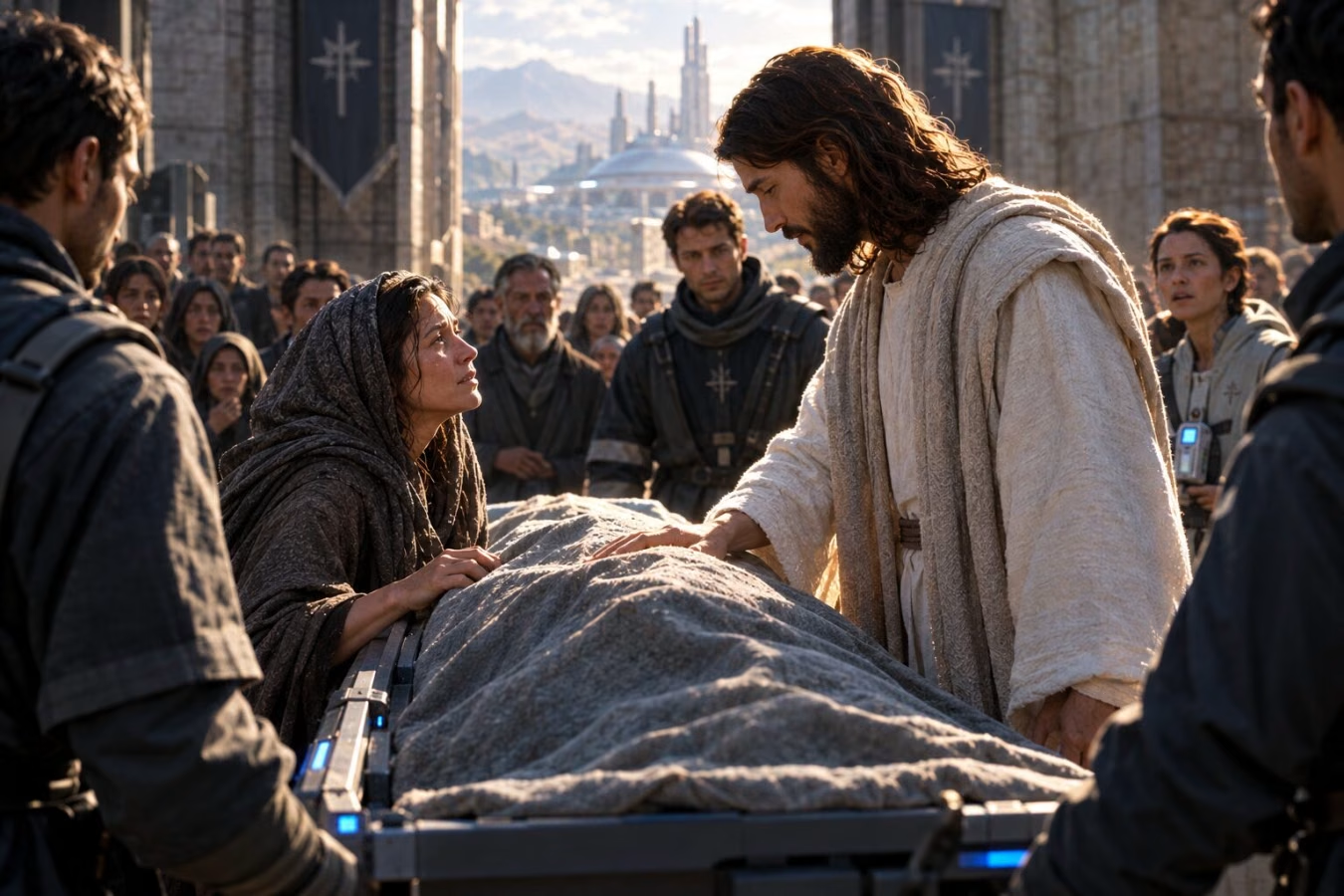 He went up to her. The bearers slowed — not because he had commanded it, but because something in his face made it impossible to walk past. Eupraxia raised her eyes, and Theodotus understood that his ready-made words would not do.
"Be strong" — the phrase one uses to close a conversation. "He did not suffer" — a lie nobody asked for. "Weep not" — he remembered that the Lord had said it, but he knew another thing as well: only He who can restore what was taken may say so. From any man, those words are mockery.
"Forgive me," he said. "I don't know what to say."
"No one does," she answered evenly.
"May I walk beside you?"
She did not reply, but moved slightly, making room for him at the edge of the platform.
He laid his palm on the cold metal beside her hand. The bearers stopped. Everyone else stopped too. The wind could be heard above the gate.
And Theodotus, who for twenty years had spoken only the right words in such places, for the first time prayed the wrong way — without formula, without words, with the heart alone: "Lord, have mercy. Thou seest her. I can do nothing. Thou canst do all."
He did not say "Arise." That word belonged not to him.
Part Four Delivered to His Mother
The gray cloth stirred.
At first no one believed their eyes. Then a breath came from beneath the cloth — ragged, hoarse, like that of a man surfacing from the deep — and the body on the platform lifted and sat up. The youth opened his eyes, looked around at the gate, the silent people, his mother, and asked in an entirely ordinary voice, one that no one would ever forget:
"Mother, why is everyone standing?"
Eupraxia did not cry out. She stretched out her hands and took his face between her palms — carefully, the way one takes something that might vanish.
Lydia, the colony's doctor, rushed to the platform with her instrument, and her face showed that she believed neither it nor herself. People stepped back; someone sank to his knees, someone covered his face. The colony's elder, a gray-haired man who had not attended services in years, said quietly and clearly:
"The Creator has visited us."
Theodotus stepped back a few paces and leaned against the gate leaf — his legs had suddenly failed him. One of the young Keepers ran up to him:
"Keeper, what did you do?"
"Nothing," Theodotus answered. "I only stopped."
Epilogue He Hath Visited His People
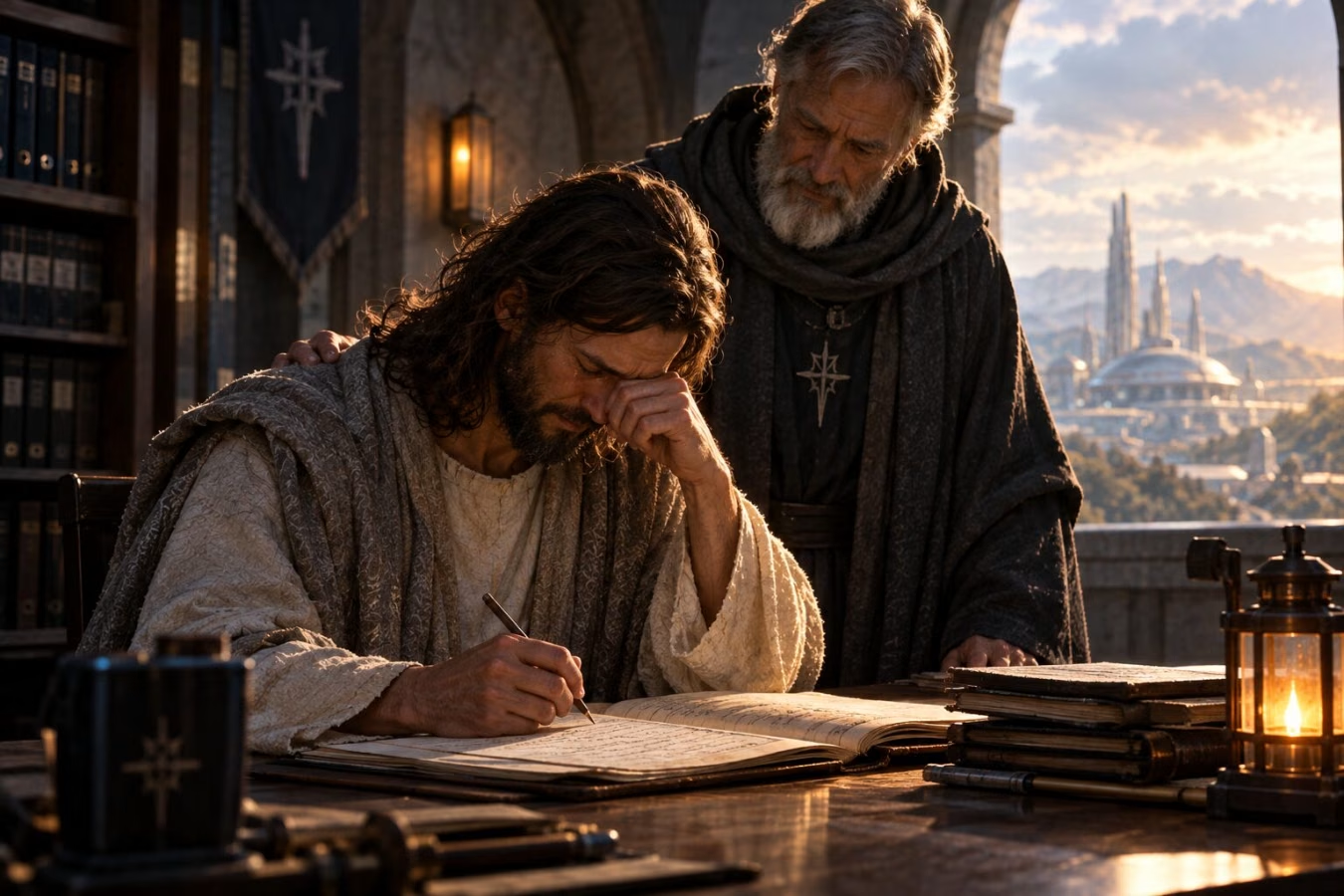 That evening, in the colony's reception hall, Theodotus opened his medical journal and gazed a long time at its last pages, full of numbers and not a single name. Then he took up a stylus and began writing in names — everyone he could recall from twenty years. He remembered more than he had thought. The faces came back one by one, each like a small wound, but a living one.
"You are weeping," said Sabbatius, who had met the convoy the next day and found him at it.
"Yes," Theodotus admitted. "For twenty years I could not. And now I cannot stop."
"Thanks be to the Creator," said the old mentor. "I warned you: guard the living thing in the heart. But I never said the living does not hurt."
Theodotus was silent for a long while.
"I raised no one," he said at last. "I cannot, and I have no right. All I did was not pass by."
"That is exactly what is entrusted to us," Sabbatius answered. "The rest belongs to Him who walks the roads and had compassion on a widow without waiting to be asked."
"Weep not" can be said only by Him who is able to restore. To us is entrusted something else: to go up, to stop, and not to pass by.
God hath visited His people — and not seldom He comes in the person of one who simply could not walk past.
Order Archives · Nahor Colony · The Colony Gate
Colonist Myron, nineteen, injured in the depressurization of a mine airlock, was pronounced dead after forty minutes of resuscitation. While the body was being carried out at the colony gate, breathing and heart activity resumed spontaneously. Keeper Theodotus, who was present, used neither equipment nor medication.
Lydia, the colony's doctor, could offer no medical explanation upon examination. The Order makes no statement about the nature of the event and insists on no particular account.
Sabbatius's note: "A miracle is God's work, not ours. What is entrusted to us is very little: not to pass by another's grief. But, it appears, even that little is enough for God to visit His people."
