
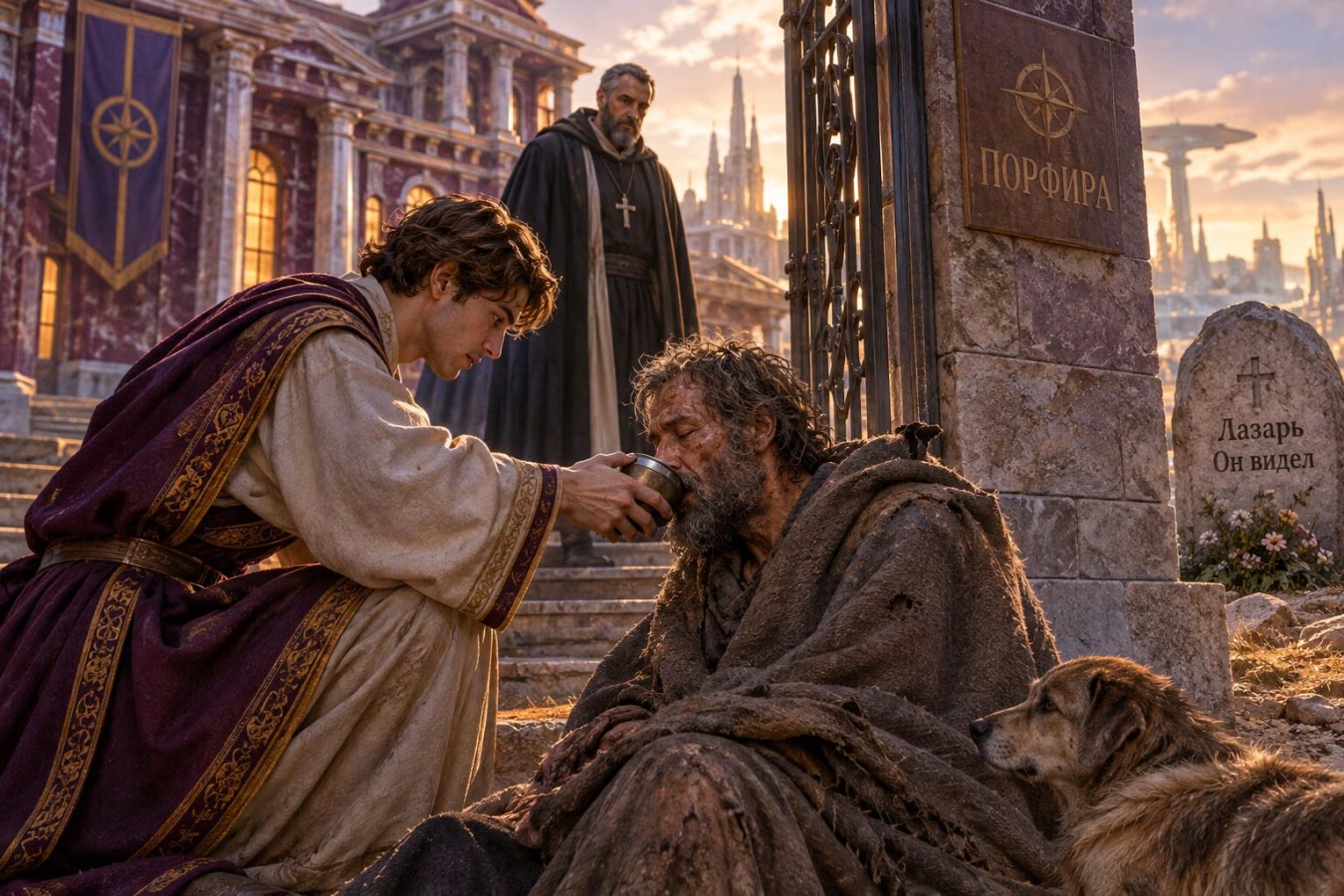
Part One Purple and Fine Linen
Cassian Vors's residence stood on the edge of the plateau, and it was called Porphyra — after the color of the marble with which the trading house had faced its front. The master owned three mines, two orbital shipyards, and the longest dining table on this side of the Rifts. Every evening forty people sat down at that table, and every evening it groaned so that servants carried out to the back yard baskets full of untouched food.
At the main gate, in a niche under the wall, lay a man. He had lain there for two years. The servants called him "the one at the gate" and stepped over his legs the way one steps over a threshold. His body was covered with sores — the marks of radiation: he had once worked in one of Vors's deep mines, and when the sickness made him unfit for work, people simply ceased to notice him.
The wild dogs that roamed around the residence sometimes came up and licked his wounds. They were the only creatures that touched him.
Cassian himself saw him every morning from the window on his way to breakfast. He had long ceased to experience it as a sight: the man at the gate had become part of the landscape, like a stone or a tree. Had anyone asked Vors whether he had any poor, he would have been honestly surprised and answered that he paid his taxes and gave to the public funds.
Part Two Lazarus
Keeper Nestor noticed him on the very day he arrived on the plateau with a convoy. He had not yet taken off his suit when he saw a body in the niche, and that very minute, thinking neither of propriety nor of whose gate it was, he dropped to his knees beside it.
"Alive," he told his young companion. "Water! A blanket! Quick!"
They carried him onto a pallet by the wall, because the guards would not let them nearer the house. Nestor gave him his own ration and softened the bread in warm water himself, because the sick man could not chew. The man drank slowly, eyes closed, and when he had finished, said quietly:
"Thank you. My name is Lazarus."
Nestor stayed on the plateau three weeks. He came every day, dressed the wounds, brought food. He learned that Lazarus had been a face-worker at Mine Thirteen and that he was about forty. He learned that he had asked nothing of Vors's house — only the crumbs the servants sometimes threw over the wall with the remains of the feast, and even those the dogs often got to first.
"Aren't you angry with them?" Nestor asked once.
Lazarus was silent a long time.
"I used to be," he said. "Not now. The Creator has given me so much... I have the sky over my head, and now you've come. Perhaps there is some reason I must lie right here."
He died at dawn on the twenty-second day. Nestor was at his side. His last words were: "Glory to the Creator for all things." The Keepers buried him on the plateau, right beside the path, and set up a simple marker with his name.
"And it came to pass, that the beggar died, and was carried by the angels into Abraham's bosom: the rich man also died, and was buried."
— Luke 16:22 (KJV)From the Teaching of St. John Chrysostom · On Lazarus and the Rich Man
"Notice: the rich man is condemned not for being rich, and not for doing evil. He did not beat the beggar, did not drive him from his gate. He simply did not notice him. This is worse than any evil: indifference, in which a man at your threshold becomes scenery. Wealth is not a sin; the sin is wealth that has closed in upon itself."
"Observe also that the beggar is named, while the rich man remains nameless. God knows the names of those whom men do not notice, and does not know the names of those who do not wish to know others. And Lazarus, in his patience, did not murmur, and so in his very poverty kept what the rich man did not keep in his riches: a human heart."
Part Three Thirst
Cassian Vors died half a year later — not of some sudden calamity, but of a long illness that had worn him down year after year while he feasted. By the last month the guests had stopped coming: there is no point in banquets when the host cannot rise from his bed. The vast house stood empty.
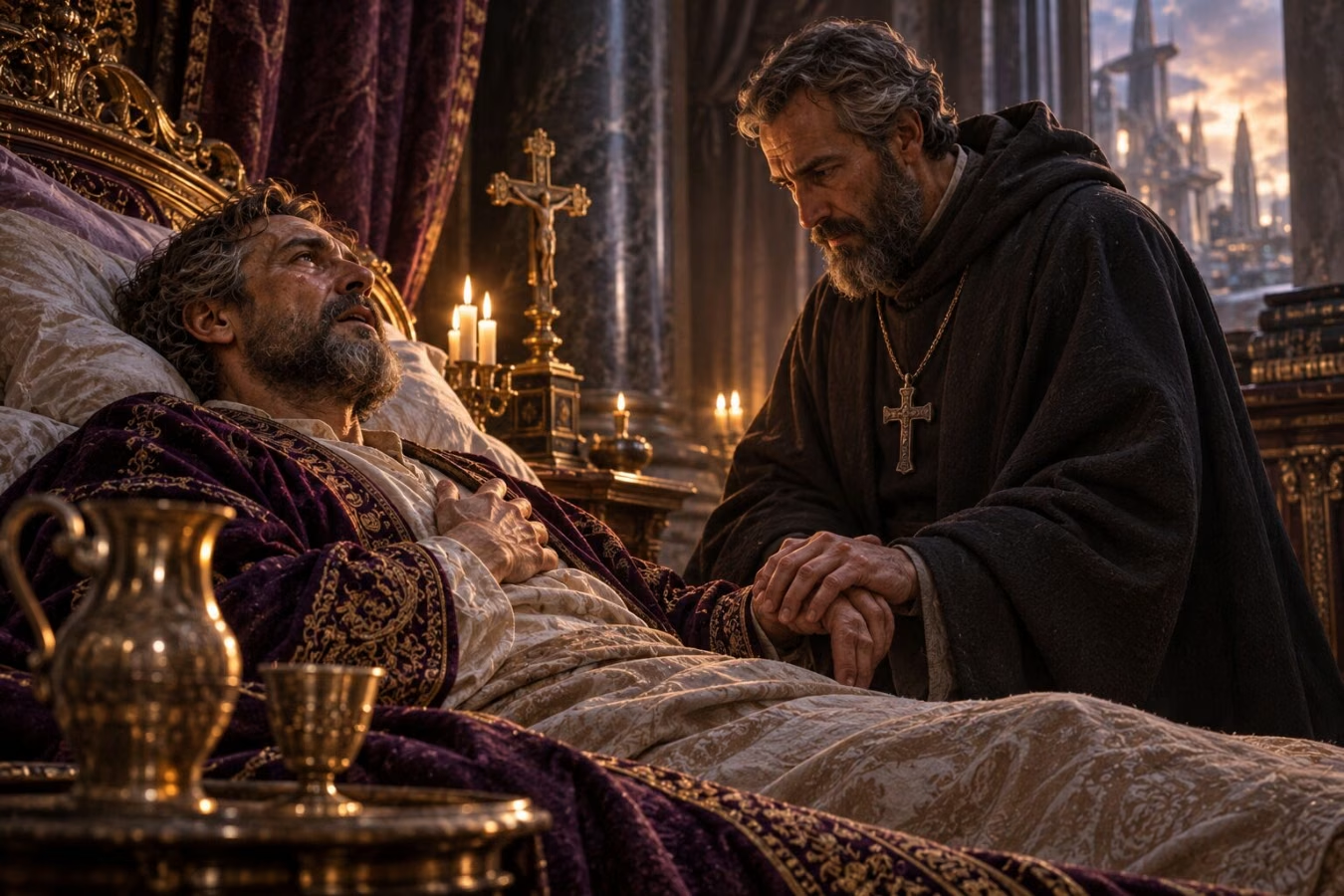 In his last week Vors sent for a Keeper. He could not himself have explained why Nestor in particular — only that he had heard the Keeper had once taken pains over "the one at the gate."
Nestor came and sat by the bed. Vors lay gazing at the ceiling, breathing heavily, with a rasp. The room was hot. His lips were cracked.
"Water," he whispered.
Nestor held up the cup. Vors took a swallow and pushed it away.
"Not that. The thirst... is not that kind. I'm burning from inside. Do you understand? As if something that lay buried a long time had finally woken and is scorching me."
"I understand," said Nestor. "It is conscience. It was silent a long while."
"That man at the gate... Lazarus. He died, didn't he?"
"Yes. Half a year ago."
Vors closed his eyes. A tear rolled slowly down his cheek.
"I saw him every day. I saw him for thirty years. And I don't remember once thinking: who is he? He was like a wall." He opened his eyes again. "Could he... could someone... some water for me. From him. Let him just... with a fingertip..."
Nestor answered nothing. He laid his palm on the rich man's hot hand and was silent, because he could not say "he will come" and could not say "he will not come."
"I have five sons," Vors whispered. "They're the same. They don't see either. Tell them... let someone come to them, let them understand..."
"They have the Scripture," Nestor said quietly. "They have the Gospel. They have you. Your life they know better than any words."
"No," Vors rasped. "If someone from the dead came... then they would believe..."
"They would not," Nestor answered gently. "He who does not hear the living will not hear the dead."
Vors died that same night. Nestor read prayers over him until dawn. He did not know what awaited this man beyond the threshold, and did not presume to judge. He only repeated: "Lord, have mercy on Thy servant Cassian."
"Son, remember that thou in thy lifetime receivedst thy good things, and likewise Lazarus evil things: but now he is comforted, and thou art tormented. And beside all this, between us and you there is a great gulf fixed."
— Luke 16:25–26 (KJV)From the Teaching of Abba Dorotheus · On Drawing Near to One's Neighbor
"Imagine a circle, and in the center of the circle, God. From the center to the circumference run rays, and these are the lives of men. The farther the rays go from the center, the farther they are from one another; the nearer to the center, the nearer they draw to one another. So it is with us: as we draw near to God we draw near to each other; as we withdraw from our neighbors we withdraw from God."
"The gulf of which the Gospel speaks was not dug on the day a man dies. It was dug in life — a stone a day, an indifferent glance, a closed door, bread thrown to the wrong one. In dying, a man merely discovers how far from others he has gone."
Part Four Five Brothers
The funeral was lavish: forty people in mourning dress, an orchestra, wreaths. Nestor read the Gospel over the coffin, and at the word "gulf" Vors's eldest son stirred with displeasure — like a man being read something out of place.
After the burial four of the brothers left for the city to divide the inheritance: the mines, the shipyards, three warehouses. They did not quarrel — they agreed quickly, like men long accustomed to everything being settled by figures.
The fifth, the youngest, Timothy, stayed behind. He was twenty-three. He stood at the main gate looking at the niche in the wall where the pallet still lay.
"I remember him," he said to Nestor, not turning. "When I was twelve I brought him bread once. Father saw it and said it was useless: you can't feed everyone. I never brought any again."
"And now?"
"Now I don't know," Timothy admitted. "I think all this time I forgot he was a person."
Nestor was silent a moment.
"The gate remains," he said at last. "The gulf begins not beyond the grave, but here, at the threshold. And here it can be filled in, while you are alive."
Epilogue The Open Gate
Timothy received Porphyra as his inheritance, because his brothers found it burdensome: too much space and too little income. He removed the dining table from the courtyard, converted the lower floor into a shelter for sick miners, and in the very first winter took in eleven men. The gate he ordered never to be closed.
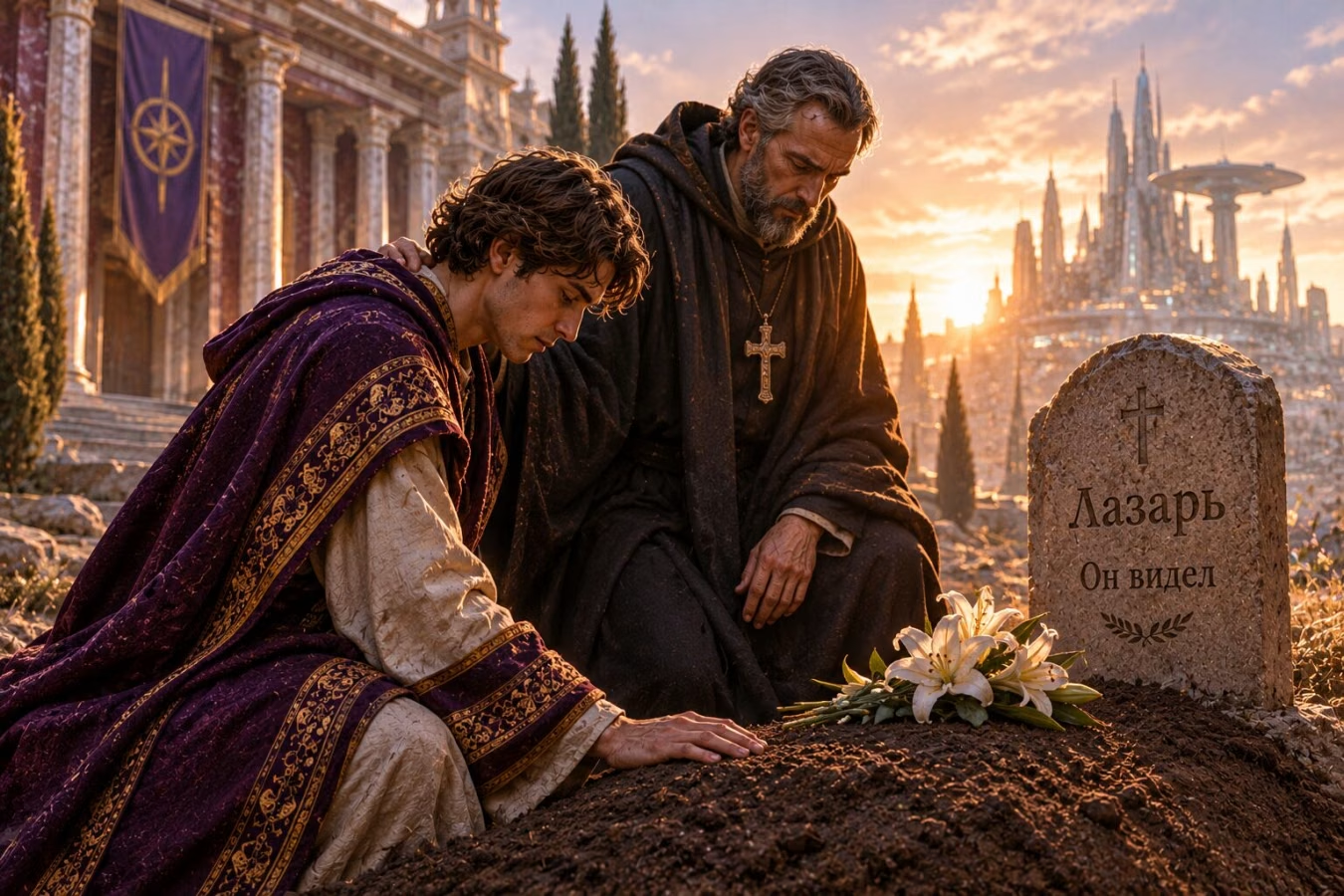 That first winter another man came to the gate — also with sores, also with eyes accustomed to not being seen. A guard started to ask who he was and what he wanted, but Timothy came out himself and shouted as he ran:
"Bring water and a blanket! Quick!"
He dropped to his knees beside the newcomer. Nestor, who had come that day on inspection, stood on the stairs and watched the youngest son of Vors, thinking neither of propriety nor of how it looked, give drink from his own hand to a stranger.
On the stone by the path where Lazarus was buried, someone by then had added two words to the simple inscription with his name: "He saw."
The gulf begins at the threshold — a stone a day. And at the threshold it can be filled in.
If we do not hear the living, we will not hear one risen from the dead. But the word already given us is enough to open the gate.
Order Archives · Porphyra Plateau · The Residence's Main Gate
Colonist Lazarus, a former face-worker of Mine Thirteen, died on the Porphyra Plateau of the effects of irradiation after two years of homelessness. Buried by the Keepers. In life he neither complained nor asked.
Cassian Vors, owner of a trading house, died half a year later. Keeper Nestor was present in his last days. The Order does not determine or discuss the state of the departed's soul.
The Porphyra residence now serves as a shelter for sick miners. Its main gate is never locked.
Nestor's note: "We fear the gulf beyond the grave so much that we forget: it is dug here, a stone for every averted glance. But it can be filled in here as well — by opening the gate and carrying out the bread."
